
Wouldn't it be wonderful if you could just build a great product, put it out there in the world and then watch as willing users flock gratefully to sign up for your new masterpiece?
It sure as hell would make my life a lot easier. Being a serial startup founder I find myself praying to the user acquisition gods more often than I would like to admit, because getting your first users is bloody hard work. However, over time I have learned that there is some sort of playbook of activities (not a formula, such things are nearly always snake-oil) that will do the job of getting the first users onto your product, regardless of what it is.
In this post I will aim to shed some light on some of these activities while explaining why they work and roughly how long they will take to deliver. These are not tricks or hacks, they are widely used strategies that work for very simple reasons, and are time-tested. I should caveat this by saying that my focus is primarily on tech startups, particularly SaaS businesses with a subscription model, so adjust your expectations accordingly if you are not in that particular sphere. Nonetheless, much of this stuff is pretty generalized marketing strategy so you should be able to get some joy regardless of your sector. YMMV, as they say.
With that said, let's start with the fundamentals.
When to start acquiring users
If you've spent any time at all in tech as either a consumer or industry professional, you will have come across at least one pre-launch landing page. These are the one-page websites dedicated to products that are yet to be launched. They tend to feature a large hero image of some kind, a bit of blurb and some sort of lead capture, normally a big email address field with an inviting Sign up for early access button. You know the ones.
What this tells you is that user acquisition can start as soon as you've had the idea for your product. In fact, it probably should. If not, you could spend weeks building a product only to discover that nobody wants it, which would be a huge waste of time. Validate your idea first, build second.
I always use Buffer as an example of early validation executed well. You can read about it on their blog here, but essentially they threw up a landing page for the product with some pricing and then tracked which pricing plan people clicked on. Ta-da: validation that not only did people want the product, but that they would pay for it. They started building it after this.
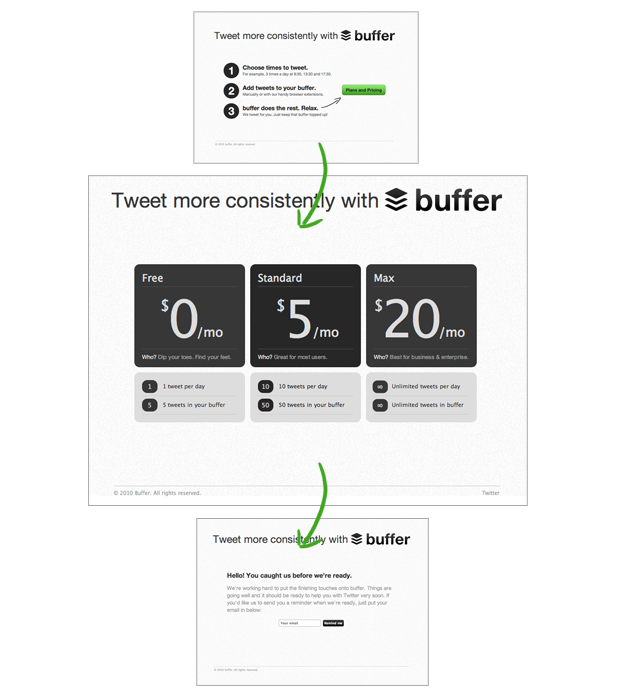
Buffer's first landing page
This was over 10 years ago now but the principle remains. Throwing up a landing page is easier than ever before now, with today’s AI-powered tools like Lovable enabling small teams to produce polished landing pages and prototypes in a fraction of the time it used to take, making it faster and cheaper than ever to validate an idea before writing a single line or product code (or getting Claude to write it for you!).
The other upside of getting users early, before you build the product, is that it will help you if you are trying to raise money. Many people assume that fundraising only happens with fully built products — or at least an MVP — but that’s not always true: many early-stage companies have raised money with nothing more than an idea and some evidence that the idea has demand. At Firedrop we raised our first round of funding with a simple prototype that took us two days to mock up, and some social proof that we were solving a genuine pain point. Our second round of funding — still pre-launch — happened because we had used some of the techniques below to acquire 8,000 early beta testers who were all itching to get their hands on the product.
Acquiring users should start as soon as possible.
Cost and speed
The next consideration is how long it will take to get to your first 1000 users. This is a function of effort, specific market, how much money/time you are willing to spend on acquisition, and even a little bit of luck. In short, there is no catch-all answer to how long it will take to get to the 1000 user milestone, but you would be sensible to set aside at least 6–12 months if you’re not really going to go hell-for-leather on this.
Money is obviously also a factor. If you have budget for advertising then your timeline will shorten significantly assuming you have a half-competent advertising strategy. There are marketing agencies who specialize in helping with this, including one I founded for precisely this reason (shameless plug).
Generally speaking though, I will assume you are building a startup with very little budget as you’re just trying to get something off the ground, and will focus this article on non-paid tactics (although you may have to pay small mounts for things like website hosting).
1. The foundations
Before you start shouting about your startup from every rooftop, make sure you’ve got your house in order. There’s nothing worse than generating a buzz that dies out because people don’t know what you’re shouting about or how to get involved.
- Get a website. Even if you’ve decided you’re not going to collect email addresses at this stage (for which I hope you have a great reason), you need to have a destination for people to land on. There are loads of options available for getting a website online quickly, but my personal favourite for early stage startups is Unicorn Platform. It’s just so simple to use, looks great, and you can hook up an email field to something like Google Sheets just to get started. It’s very cheap too. Of course there are lots of AI website builders now — a field I am very familiar with thanks to my previous venture, Firedrop, where we built one of the world’s first AI-powered website builders in 2017 — and those can be great if you know what you’re doing, but often need a bit more wiring and fiddling to get great results. Having said that, my agency Growthmode’s website was built with Lovable so good results are possible.
- Buy a domain name. Not strictly essential as most website builder platforms do provide a URL for you, but it is highly recommended. A professional domain is more likely to get users to sign up because it provides assurance of professionalism. Domains are dirt cheap nowadays, you can get a .com or a .io (ideal for tech startups) for less than £10 per year. I tend to recommend Namecheap for this.
- Grab your social media URLs. This is a defensive tactic but one you will regret not doing if your startup takes off. Grab the URLs for every single social media channel you can think of. The idea isn’t to start using them all yet, merely to prevent someone else grabbing the name.
As an aside, here are some things not to do at this stage, which I only mention because I’ve seen so many people get over-excited once they’ve got their website online:
- Don’t register a company. Once you’ve registered a limited company you immediately add unnecessary admin to your workload. Hold off until you are taking money from either sales or investment.
- Don’t buy business cards. Honestly, nobody really cares about business cards these days and they’re a waste of money. I still see people doing this and it baffles me. Just exchange Linkedin profiles on your phone when you meet people.
- Don’t pay for a professionally designed logo. You’ll probably change your logo once your startup takes off. Just use a free logo builder like Canva’s one for now. Or any one of the bazillion AI logo builders out there. Honestly, it doesn’t matter at this stage.
- Don’t quit your day job. It’s going to take you much longer than you think before your startup is going to be able to pay you. Don’t cut off your source of income before you can afford to.
2. The target audience
This might sound boring, but before you can start marketing your startup you need to do some groundwork to ensure you’re doing the right things. As minimums, I would strongly urge you to:
- Create a user persona or avatar. Understanding your target market is one of the most critical things you’ll need to grasp if you’re going to make a success of your startup, not just now but in future too. At this early stage, doing the work of sketching out a proper persona or avatar will really help you to nail the messaging you can use to speak to them, as well as giving you some insights into where to find your users. You can grab a template for a user avatar here. For research use Gemini, which I personally find to be the best LLM for structured content like this — plus its deep integration with Google gives it the best research tool in the AI market, in my opinion. But any of the top LLMs will also do a good job.
- Understand the adoption curve. The way people find and sign up for any given product is usually the same: it starts off with a small number of technically savvy enthusiasts who are curious about the product and willing to invest time in trying it out, before the userbase grows through progressive levels of risk tolerance and excitement. At this early stage you’re targeting the first tranche of the curve (see below) — the Innovators — with the goal of getting them to attract the early adopters.
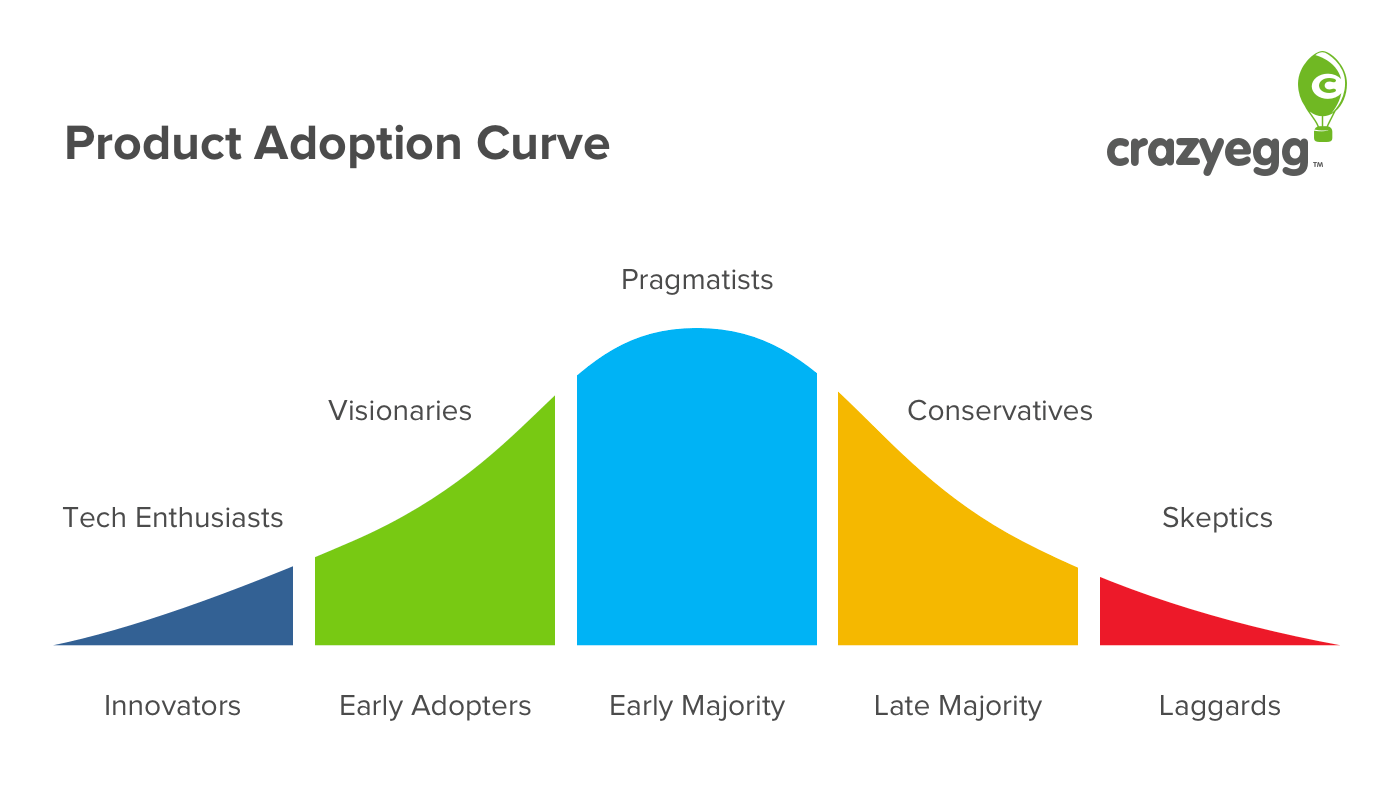
Source: CrazyEgg
- Nail your audience’s pain points. This should have come out of your avatar if you’ve done that, but really understanding your audience’s pain points will give you the focus needed to hit them with the right messaging, in the right place. Don’t just focus on the pain point you’re trying to solve, think about the other related pain points too. This will help you with content marketing (see section 5) as well as engineering-as-marketing (section 6). Again, use a tool like Gemini or NotebookLM to do your research here. A particularly useful technique is to ask the LLM to put itself in the shoes of your target audience and challenge your pitch. They’re pretty good at that, and if you want real brutal honesty then give Grok a try (only if you have a thick skin!).
Now this may all sound very obvious, but I can’t stress enough how important it is to actually go through the process of understanding your playing field, as very often our own bias obscures insights that we would miss without going through the thought process in a systematic way. Set aside some time for a brainstorm and write down your user avatar and pain points. You can even stick them on the wall if you’re into that kind of thing.
3. The first 100 users
Now we’re getting into the actionable checklists. Going from 0 to 100 users is a great first step; you’ll feel validated and the thrill of seeing things starting to happen will motivate you. Here’s what you should do.
- Tell everyone you know. So many people miss this obvious step, but it’s a really important and easy one. Broadcast your new startup to your network on social media, email people, talk about it with everyone who might be interested. Encourage them to visit the website and sign up, and nag people to share it with their networks too. You might become a pain in the backside within your social circle, but I’m sure they will still love you and more importantly, want to support you.
- Post it on Betalist and similar sites. There are lots of websites focused solely on showcasing new startups. Betalist is great for pre-launch campaigns and you can get featured for $200 if you have it (otherwise there is a free listing option). Other similar sites which accept submissions at various stages of pre-launch are Betafy.co, BetaTesters.io, 10Words, BetaTesting, LaunchingNext… the list goes on. If your product has any AI functionality, also submit to modern AI aggregators like “There’s an AI for that” — these directories have become major discovery channels in their own right.
- It’s a bit outdated at this point (2023), but you can also go through this list of 280 directories where you can publish your startup. This is an excellent curated list of places where you can share the URL of your startup, which will not only give you direct traffic but also generate fantastic SEO opportunity. If you’ve got a bit of money to invest, you could grab this list, stick it in a database in Clay and use their AI enrichment APIs to clean/update the list (I’l write an article about that at some point soon).
That should be enough to get you over the 100 users mark. If it doesn’t, use this as a signal that your product or idea may not be of interest, and you should re-evaluate. Or, keep reading to try some of the other tactics below.
4. Engaging the innovators
Having got your first few users and gained some early validation of the product idea, it’s time to throw yourself into the lions’ den and start targeting the tech enthusiasts. This means engaging with them where they live. Here are some ideas:
- Post your startup on Reddit. If you’re looking for tech enthusiasts, Reddit is the place. It also happens to be the fourth most popular website in the world, which not many people realize. If you’re not familiar, it’s essentially a forum platform with lots of communities — called subreddits — for different interests. There are several subreddits you could post your startup to, including /r/startups, /r/startup_ideas, /r/startup, or even /r/roastmystartup if you’re feeling thick-skinned. You should also target subreddits focused on the topic or pain point your startup is aiming to address, as well as join in with the communities aimed at entrepreneurs such as /r/entrepreneurridealong. Just be mindful of the rules in each subreddit and don’t spam the site. There is a great write-up of relevant subreddits over at GummySearch, which is also a brilliant tool for Reddit audience research.
- Submit to ProductHunt. In many ways, ProductHunt is similar to Betalist et al but with a higher cachet. The idea is to be “hunted”, aka discovered, by one of the website’s members, which adds an element of prestige and authenticity to a listing on the site. It’s also generally a one-shot deal so you need to get it right, but with careful preparation and coordination it can be a huge boost. Here is a guide to help you prepare and launch on ProductHunt. As with Betalist, if your product has an AI angle, make sure you’re also listed on AI-specific directories like “There’s an AI for that” to cover that increasingly important discovery channel.
- Find and engage with relevant people on social. Find and follow influencers in your industry and start commenting on their content. Use scraping tools on Apify combined with LLMs to identify customer pain points as they are expressed live online. If you’re less technical, you can simply set up monitoring using a social listening tool like Awario and identify people who are engaging with your competitors or related brands. The one thing to keep in mind is the target audience: if you’re after business customers for your B2B startup, focus on Linkedin. If you’re targeting young consumers and have good visual content, look on TikTok or Instagram. Engaging on social is something you need to do alongside your actual posting strategy (more on that next).
- Join Slack communities and Discord servers in your niche and answer questions there — these are where early adopters and B2B buyers actually spend their time now. Just look for relevant or interesting topics to participate in. Don’t constantly plug your product, just provide value and mention your startup when it’s actually helpful.
- Answer questions on forums and Hacker News. Niche forums are still a thing, and many of your users might be found lurking on forums related to your industry or topic. If so, sign up and start answering questions, particularly if they relate to one of the pain points you are aiming to solve. Hacker News is one of the most powerful platforms for this if you have a tech audience — use the “Show HN” format to showcase your product and engage with the community. LinkedIn groups and Slack communities are also decent sources for this kind of engagement. The founders of Unbounce invested a lot of time early on in answering questions on forums and community platforms, and it paid off handsomely.
A bit of groundwork engaging with your target audience in their own communities can pay huge dividends. When Firedrop got posted on Hacker News we acquired 2000 new users in 24 hours!
5. Content marketing
This is where the proper marketing effort comes in, but it is probably the single most effective technique for getting early traction that I have seen being consistently effective. Content marketing is a chore, but it’s much less of one nowadays thanks to AI, and it still really works.
Quick note on use of AI to create content: it’s absolutely fine to use AI to help you with your content, but just spamming out articles written by ChatGPT is a guaranteed way to destroy your reputation. And, frankly, it’s a terrible thing to do. Instead, use AI to do all of your research, help you with topic ideas and outlines, find sources, find useful sites to link to, and then work with the AI bit by bit, editing heavily as you go. It is very possible to create quality content with LLMs, but don’t hand over your entire magic to the machine. You’ll get the same outcome as if you just dumped all of your content onto a high-volume offshore content farm. That said, here’s what you should focus on.
- Blogging. Writing about topics that are interesting to your target audience (see why it’s so important to understand your audience?) will not only give you great SEO/GEO juice that will drive traffic to your website, it will also give you additional material to post on your socials as well as sites like Reddit. Write well, and write regularly, and this could be enough to land you your first 1000 users on its own. It certainly worked for Buffer, Mint, Plausible and many other startups. You can set up a blog on your own website using something like Ghost at a subdomain (blog.mywebsite.com), or start a founder-led newsletter on Substack. In fact, Substack has become one of the best ways to build an early audience — a regular newsletter gives you a direct line to your readers’ inboxes without relying on algorithms, and it doubles as your content marketing engine. Don’t like Substack? There’s always the world’s best social blogging platform Medium. And if you’ve been lured in by on-line “experts” claiming that SEO is dead, rest assured that it is very much not dead, it’s just changed its mechanics somewhat. See next section.
- Promote your blog posts and newsletter on social. Seems like an obvious one but many people forget this part. Every time you publish an article or newsletter edition, tell everyone about it! Not just your followers either, it’s fair game to @mention relevant influencers to ask their opinion on your content.
- Email your blog posts to your signup list. Another oft-overlooked promotional avenue for blog content, the people who sign up for early access via your landing page. Assuming you’ve got their opt-in permission, email them each time you write an article and encourage them to share and invite other people to sign up to your landing page.
- Repost your blogs on Medium and Linkedin. It takes a bit of effort but extends your reach significantly. If you’re hosting your own blog site, you can even make this semi-automated for reposting to Medium by using their import feature. Just don’t copy/paste articles all over the place without ensuring the repost has the canonical meta tag, or you’ll get punished by Google for duplicate content.
- Guest blogging. When you’re starting out your audience will probably be tiny, so guest blogging is a great way of piggy-backing on someone else’s established audience. Reach out to niche blogs in your industry and offer to write for them. If you’ve got time, you can even go after the bigger blogs as well; if a Wired or TechCrunch feature you, you’ll get a huge boost. When Firedrop got featured on Wired, our inbound activities made a massive leap in terms of both quantity and quality.
- Sign up for media matchmaking platforms like Qwoted or Source of Sources (SOS). These services connect journalists working on a story with industry experts who can provide commentary. By registering as an expert source, you will receive notifications from writers actively looking for quotes or interviews. This is a highly effective way to generate valuable publicity, establish your authority, and build high-quality backlinks for your all-important SEO efforts.
- No time for blogging? Micro-blog on social media instead. LinkedIn and X are especially good for short-form mini-articles where you can tell a short story instead of writing a full blog post. You can also post carousels on Instagram of mini presentations that offer value to your audience. Don’t like writing? Post regular insightful videos on Instagram or TikTok if that’s where your audience is.
Content marketing is one of the most widely used and effective ways of growing your user base, but it’s important to be realistic about the time it will take. You will need to be posting regularly — at least once or twice per week — for a period of 6 months or more before you can reasonably expect it to take off. If your focus is more on social media posting, up the intervals to once per day at least, on top of your efforts to engage with other users. Use AI intelligently and this is very manageable with just one person.
Finally — and this is really important — make sure to focus on quality over quantity. As mentioned earlier, resist the temptation to just use LLMs or outsource your article-writing to volume-focused Fiverr freelancers. People are wise to blogspam and it will hurt your brand if you are seen to be peddling poor quality content for the sake of it.
6. Optimise for AI discovery (GEO)
If you’re building a startup today, traditional SEO alone is no longer enough. Increasingly, your potential users are discovering products not through a Google search results page but through AI-powered discovery engines like ChatGPT, Perplexity, and Google’s AI Overviews. This shift means you need to think about Generative Engine Optimisation (GEO) alongside your conventional SEO efforts.
The difference between SEO and GEO
Traditional SEO is about getting a human to click a link to your website. You achieve this by matching keywords, building backlinks, and structuring your site for search engine crawlers. All pretty well-established stuff with loads of content online about it (or check out this article “Non-obvious SEO advice to startups” by Posthog).
Generative Engine Optimisation is about getting an AI model to include your brand in its generated answer. You achieve this by providing what’s called “unique information gain”: in other words, creating unique insight that isn’t repeated anywhere else, adding to a topic or discussion rather than just repeating what others have said. AI models therefore want primary data, strong opinions, and first-hand experience. They also look at third-party platforms like Reddit and Hacker News to validate your credibility, so the cross-posting tips from the previous section matter even more than they did.
- Write from first-hand experience. Blog posts that share your own data, your own mistakes, and your own unique perspective are exactly what AI models prioritise when generating answers. Generic “Top 10 tips” listicles won’t cut it. Be the primary source. If you have original research, benchmarks, case studies, or proprietary data, publish it. AI models are far more likely to cite primary sources than secondary ones.
- Structure your content clearly. Use descriptive headings, clear definitions, and well-organised sections. AI models parse structured content more effectively, which increases the likelihood of being cited.
- Build topical authority. Consistently publishing deep, focused content on your niche signals to both search engines and AI models that you’re an authoritative source on that topic. This doesn’t replace traditional SEO — you still need good keyword strategy, quality backlinks and technical fundamentals — but layering GEO on top of your content marketing efforts gives you a second, increasingly important discovery channel that most of your competitors are probably ignoring.
In a nutshell: SEO relies mostly on what you publish on your own domain. GEO relies heavily on your footprint across the wider internet. So building that authority and unique voice is essential.
You must also make sure your website is machine-readable. AI models do not perceive websites the way humans do. They get distracted by complex navigation, JavaScript, and digital clutter. Here are the technical steps to optimise for AI ingestion:
- Implement an llms.txt file. This is an emerging web standard designed specifically for AI crawlers. It is a simple Markdown file placed at the root of your domain (e.g. yourdomain.com/llms.txt). It acts as a curated directory, pointing language models directly to your most important, distraction-free content. SEMRush have a pretty good guide on how to create an llms.txt.
- Provide an llms-full.txt file. If you host technical documentation, you can also provide an
llms-full.txtfile. This compiles the complete plaintext content of your documentation into a single file. It allows AI agents and coding assistants to ingest your resources instantly without scraping multiple pages. - Use clean, structured markup. Use clear H1, H2, and H3 headings to establish hierarchy. Keep paragraphs short and self-contained. Use bullet points for key takeaways so that models can extract them easily. This is also important for SEO, but possibly even more so for GEO.
- Keep URLs stable. Changing your page URLs can break the historical references and embeddings that AI models use to map information. Ensure your core pages remain at the same address.
7. Engineering as marketing
If you have a tech startup there’s a reasonable chance you have programming skills within your founder group. Use it.
There are plenty of examples of startups who have successfully leveraged their engineering skills to build traction by building mini-products and in-app features whose sole purpose is to provide value to their audience while capturing their details and/or encouraging signups. Below are a couple of examples to inspire you.
Dropbox’s referral program
In 2008 Dropbox had 100k users. Less than 1.5 years later, they had 4million. Their main source of growth was a simple referral program, built into their app. Between 2008 and 2010, their users sent out 2.8 million invites to other people encouraging them to sign up to Dropbox. Existing users were incentivized with free storage space for every friend they invited, and users jumped at the opportunity.
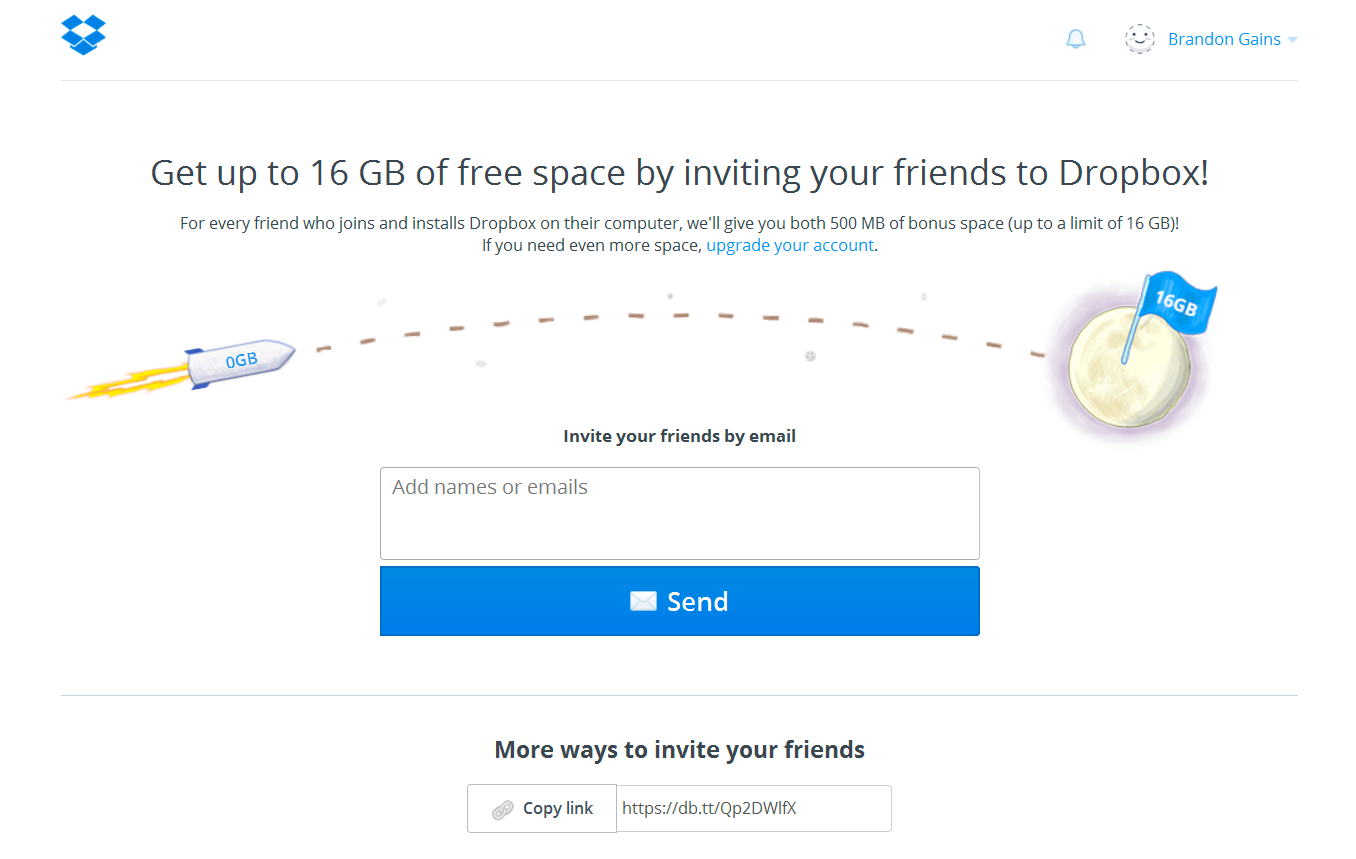
Dropbox's referral program in 2008
This approach worked because it leveraged the enthusiasm of the platform’s early innovators and encouraged them to spread word out to the early adopters further up the product adoption curve. In SaaS products, referral programs can be very powerful and often simple to implement. Trello used a similar approach with similar success.
SEMRush’s free site audit tool
Developing free lead magnet products like a free audit tool is still an effective strategy, because it quite simply delivers value for nothing to potential users while simultaneously building your brand in their mind. In SEMRush’s case, they try to tempt you to sign up before using their tool but this is entirely optional. Once you get past the sign-up screen they let you in to a restricted version of their full app, effectively allowing you to try the product out for free.
WPEngine, a Wordpress hosting platform, did something similar with a simple tool that offered to speed test your Wordpress site in exchange for your email address. This tool was credited with playing a significant part in their ascent to market dominance in an extremely crowded space.
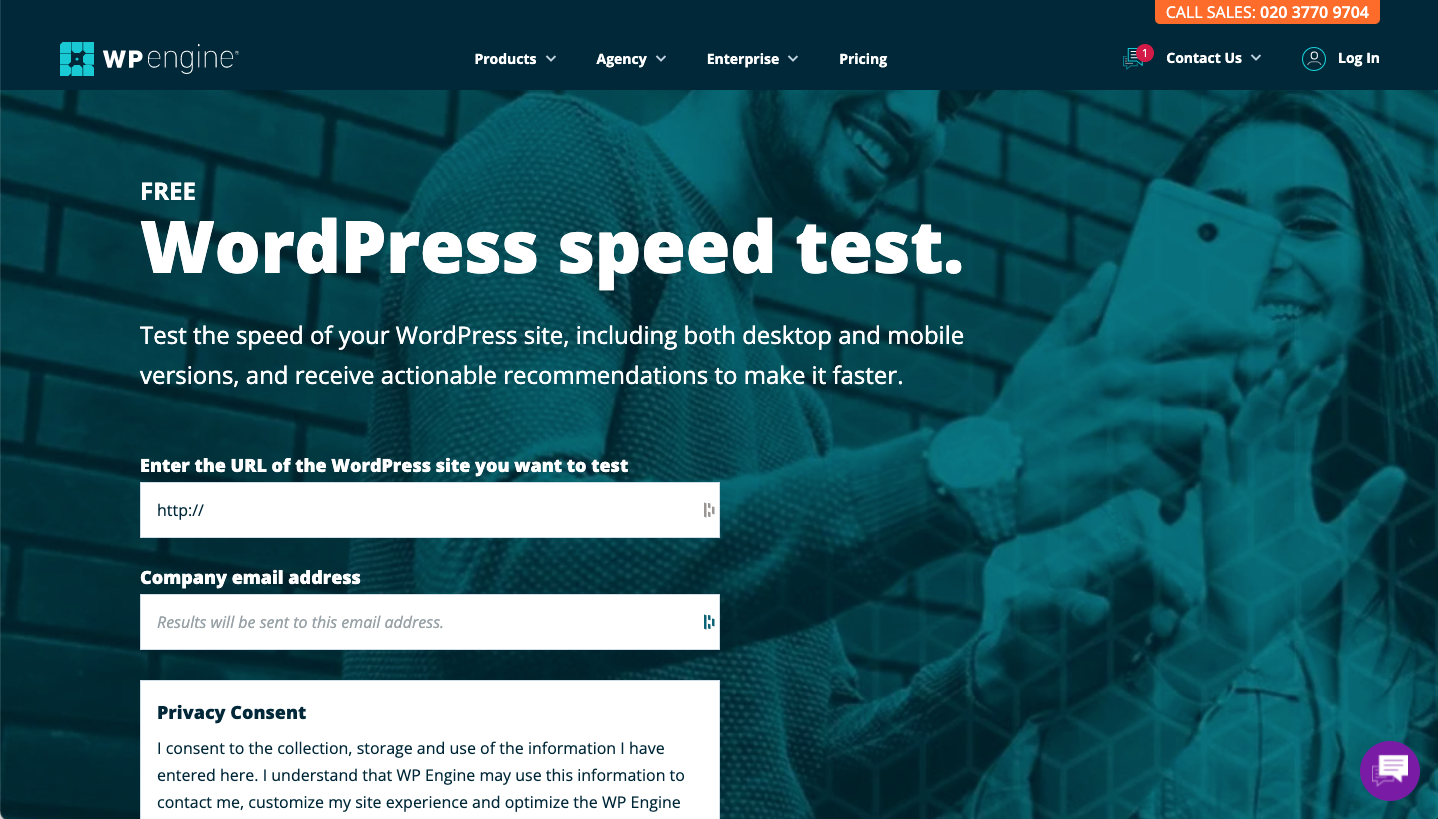
The reason these approaches work is that they target their customers' main pain points and amplify it so that potential users are inclined to sign up to their platform to solve the problems. SEMRush's audits will nearly always throw up warnings and errors, and WPEngine's speed testing tool will tell you your site could be faster. In other words, telling people that the way they're doing things is bad is far more effective than just selling features to them. As human beings we respond much more strongly to negative stimuli than positive ones.
Get creative. Focus on the pain points and how you can hook potential customers in by allowing them to evaluate a problem they might have, and push your product as the solution.
The best thing about engineering-as-marketing strategies is that they can be evergreen, bringing you new customers for years after your initial traction efforts.
8. Evaluate, iterate, experiment
I have deliberately chosen a narrow route to just your first 1000 users in an effort to present an easily-achievable strategy that won’t cost money and can be executed by most people well. However, whatever you do it’s important to measure and track results. One big mistake startup founders make is sticking to a failing strategy and then throwing their arms up in frustration that it’s not working.
In truth there are many variables that can impact the effectiveness of any given strategy, so you need to measure everything you do and adapt accordingly. Here are some simple ways of doing that.
- Get familiar with website analytics tools. Whether you’re using Google Analytics 4 or one of the more privacy-focused solutions like Fathom, get into the habit of tracking your efforts and learning from them. This is especially true with content marketing: if you find out that one type of content or topic gets a particularly big hit rate, try more articles on that same subject. Similarly, if a topic is a dud, stop wasting time writing further similar articles. Measure where your traffic is coming from. Is Reddit a good referrer for you? See if you can spend more time on contributing to the platform by engaging in discussions and posting more content. Do you have a lot of visitors from Hacker News? Get more involved in those communities. It’s all common sense really.
- Try different messaging on social media. Social is actually helpful in learning to understand the type of content that people want to engage with, so first of all spend some time following competitors and influencers in your industry and analyzing the type of content they post. Then try different approaches on your own audience and measure the response. Double down on what works, drop what doesn’t work. Just remember that your audience size will need to be something reasonably significant before this is useful, but the same principle applies to the earlier stages of engaging with influencers in comment threads and so on. If you’re posting visual content on platforms like Instagram, try different styles of design and messaging. Use Canva to experiment with different aesthetic styles, and try little tweaks to the copy like adding emojis.
- Speak to your early users. This is so, so important and something that so many startup founders fail to do for whatever reason. Once a user has signed up to your early-stage or pre-launch product list, they’re a potential advocate. Speak to them frequently, email them personally to invite them to a call to discuss their feedback and suggestions, ask them what they would do differently. The very first users will happily contribute and are therefore an essential source of measurement and improvement.
Conclusion
The tactics discussed in this article are a small handful of free or almost free activities you can engage in to build up your first base of users. If applied correctly and consistently, I can say with reasonable certainty that they will get you to the first 1000 users and quite likely beyond if executed well enough. There are other tactics that require different skills and, usually, some spend. If your budget is tight or you’re not especially experienced in marketing, it’s usually best to look at these later on, or experiment with them carefully. However, there are times where other tactics may be the best option for you and so here are some of the best ones, briefly:
- Paid online advertising. Buying ads on platforms like Google, Meta, Instagram etc can be extremely effective if done right. You will need to be good at copywriting and design (or extremely good with AI — see earlier comments about that), and invest some time into learning how the ad platforms operate — itself no small undertaking as they are generally quite complicated — if you want to get the best return on your spend. I also always recommend looking into paid ads only once you have some data of your own to bring to the party, so that you can leverage the more effective approaches like retargeting and custom audiences. In the last couple of years there has been a heavy push back against third party data so you’ll need to use your own. If you’re interested in paid online advertising, speak to Growthmode which I am a founder of. We’ll help you get the best returns without wasting your money (that’s the last shameless plug for this article, honest).
- Signal-based outbound. Let me be blunt: mass cold email is dead, and, frankly, good riddance. AI-powered spam filters have made generic outbound blasts almost completely ineffective, and your emails will end up in the void. Instead, if outbound is part of your strategy, look at signal-based, highly personalised automation using tools like Clay. These platforms allow you to identify intent signals — like someone visiting your website, engaging with a competitor, or posting about a relevant pain point — and then craft genuinely personalised outreach based on those signals. It’s a world apart from the old spray-and-pray approach, and it actually works. If your customer is B2B, this is an extremely powerful and sophisticated strategy, albeit not easy to execute well.
- Public Relations and press. Publicity is often an excellent way of building buzz around a product, but it’s not a straightforward process. You really only have three options: create enough noise on blogs and social to get picked up by journalists; pitch to journalists directly; or hire a PR firm to do all this for you. The latter is the risky option and I would only recommend engaging a PR firm if you really have a unique and compelling product and a lot of money to throw at it. PR firms are only as good as their network, so research which publications they work with and get examples of coverage they have achieved in the past.
- Publicity stunts. If you’re the creative type and are willing to invest the time and effort into one-off efforts that don’t scale, consider it. Publicity stunts are generally the domain of larger companies but many startups have used cheaper stunts to gain traction. For example, the founder of Tinder went around university campuses giving presentations at sororities and fraternities. In the pitches she would attend a sorority, persuade all the attendees to install Tinder, and then would go immediately to the sorority’s favoured fraternity and persuade the guys to install the app as well, where they would immediately see a bunch of girls they knew from the nearby sorority. A simple, effective stunt that doesn’t scale but it got them 15,000 users. Just be aware that publicity stunts do carry risk and can backfire if not executed correctly.
- Speaking engagements. Everyone’s a professional public speaker nowadays, but speaking engagements should not be dismissed as a means of generating leads for your startup, especially if you are B2B focused. Industry events are a prime target for speakers and you can work on generating engagements by pitching the event organizers who, don’t forget, need to fill up their event’s schedule with relevant speakers. Do this with plenty of time in advance of the event itself though otherwise the speaking slots will likely be filled.
- Trade shows and events. If your startup is B2B, trade shows are still a solid way of finding new customers. There are increasing numbers of virtual and hybrid events to attend, making it easier than ever before to attend. If you have budget, hire a stand to present your product, or if not then just circulate and talk to other vendors. It can be a great opportunity to forge potential partnerships or even just get inside information on your competitors. Even if you’re not a B2B product, events can connect you to journalists who could in turn create excellent publicity.
I could go on, as there are seemingly endless ways to build traction especially once you want to go past the 1000 mark. One thing to know is that you will need to change strategy fairly frequently as each stage of growth takes shape. What worked in getting your first 1000 users may not work in getting the next 99,000. Keep experimenting, measuring and adapting. And keep the consistency.
If you want to dig deeper, I would recommend Traction by Gabriel Weinberg (founder of privacy-first search engine DuckDuckGo) and Justin Mares, which covers the 19 most commonly used channels in a very digestible format.
For now, feel free to hit me up for a no-strings chat if you want more specific input into your own startup early-stage traction strategy. I’m always happy to talk to startup founders.